
Solar Inverter Buyer Guide: On-Grid vs Hybrid vs Off-Grid
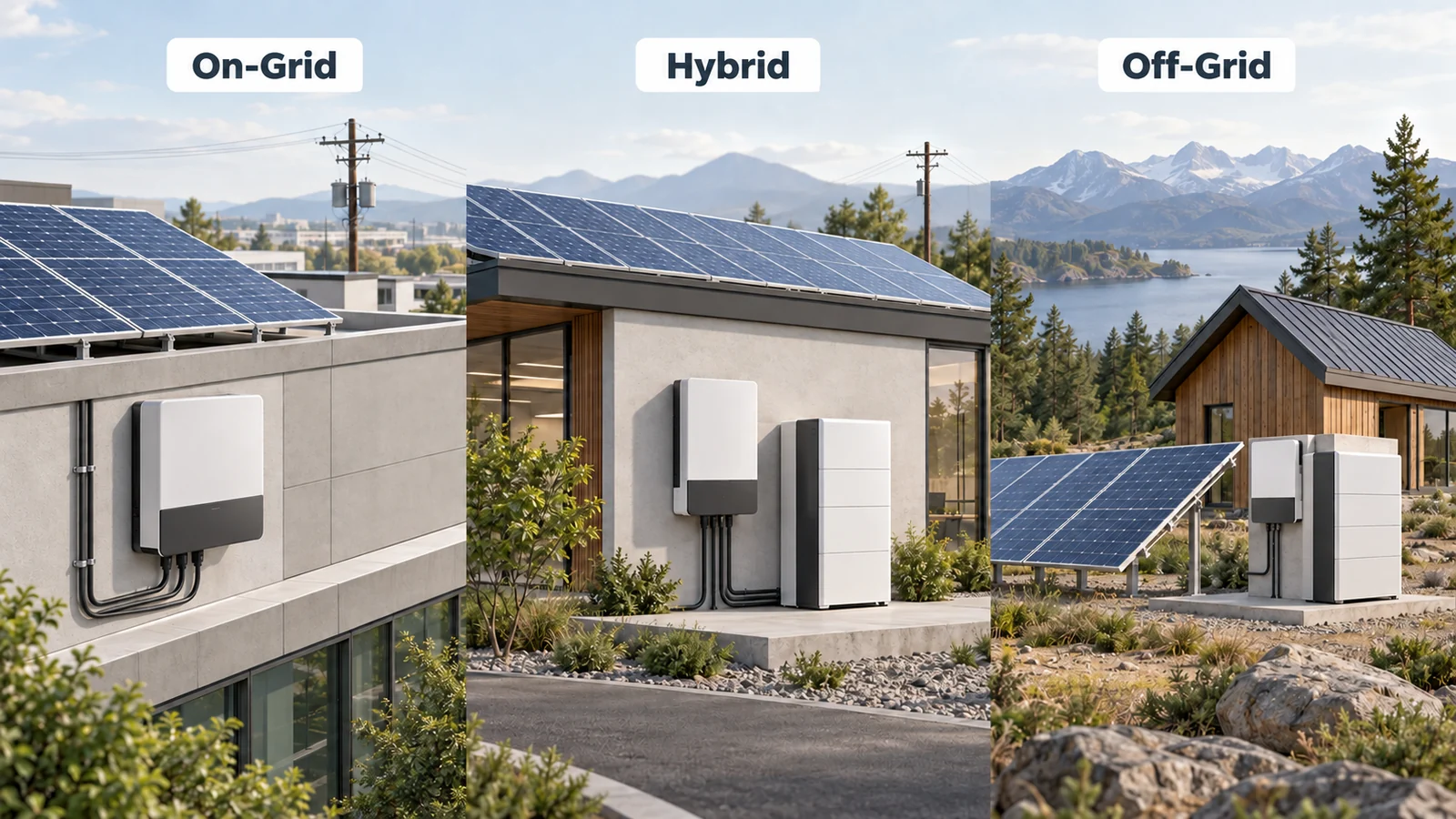
Start with the site: its grid conditions and its backup needs are the first inputs — not the only ones — when you compare on-grid, hybrid and off-grid inverters. This guide is written for B2B buyers — distributors, EPCs and project developers — who need to shortlist an architecture quickly, then confirm the exact model against the project requirements and the manufacturer datasheet.
The three architectures in one line each
- On-grid (grid-tied): the inverter feeds PV power into the utility grid, typically without a battery or backup.
- Hybrid: the inverter manages PV, a battery and the grid together. Backup is available only on models and configurations that include it.
- Off-grid: the inverter runs independently of the grid, typically with a battery bank as the energy source.
On-grid inverters — for grid-connected PV
On-grid inverters are commonly used for rooftops and ground-mount systems where the grid is available and stable, and where backup is not required. They convert DC from the PV array to AC synchronised with the grid.
Typical on-grid fit
- Residential and commercial rooftop PV on a stable grid.
- Projects with a grid-export or feed-in arrangement — confirm the local rules for the destination market before choosing an architecture.
When on-grid is not the right fit
- The site needs power during grid outages.
- There is no grid at all; compare off-grid instead.
Hybrid inverters — when the project needs storage and backup
A hybrid inverter combines PV conversion with battery charge/discharge control, so it can manage solar, a battery and the grid in one unit. It is a common choice when a buyer wants self-consumption, peak shaving or backup without running two separate systems.
Typical hybrid fit
- Residential or commercial systems that add battery storage now or later.
- Sites that need backup for critical loads, where the selected model and configuration support it.
Backup depends on the model and configuration
Backup is not a standard feature of every hybrid inverter. It depends on the specific model, its backup output rating, the loads to be backed up, and the transfer or backup configuration installed. A hybrid model without the required backup output or configuration may still be grid-tied only.
Confirm the backup capability, the backed-up load rating and the wiring arrangement in the approved datasheet for the exact model before the unit is written into the design.
On this site, hybrid families are published alongside grid-tied families, and storage options include LFP batteries and all-in-one home ESS — see the energy storage range. Match the hybrid model and the battery capacity to the site load before quotation.
Off-grid inverters — independent power
Off-grid inverters operate without a utility grid: the PV array and a battery bank supply the load, and the inverter creates its own AC. This suits remote or isolated sites.
What to confirm before quoting
- Battery bank sizing.
- Daytime versus night-time load profile.
- Surge loads.
B2B selection checklist
Before asking for a quotation, confirm:
- Grid: connected, weak, or none?
- Phase: single-phase or three-phase?
- Power class: what nominal AC output is required?
- Backup: is backup needed, and for which loads?
- Storage: battery now, later, or never?
- Market rules: the grid code and certification required for the destination market.
- Quantity and delivery schedule.
Published inverter families
TRESUN-TECH's published inverter range covers grid-tied, hybrid and off-grid families for residential, commercial, industrial and utility-scale solar projects. The brand and family names below are the published product designations; model availability is confirmed at quotation.
Grid-tied families
- The Growatt MOD 10–15KTL3-X three-phase family.
- The Deye SUN-18/20/25K-G05 range.
- The Growatt MIN 2500–6000TL-X residential family.
- The Solis S6-GU350K-EHV utility-scale model.
Hybrid families
- The OCT-S-I-6KW platform.
- The OCT-S-I 8-12KW platform.
- The OCT-T-I-15KW platform.
Off-grid family
- The BIN-S-I-6KW off-grid platform.
Specifications shown on this site are taken from the datasheets referenced on the relevant product pages. Confirm the approved datasheet for the exact model and configuration before order.
Frequently asked questions
Which inverter brands and series are published?
Our published inverter families are listed under Growatt, Deye, Solis and other platforms on the solar inverter range page. The exact models available for your project are confirmed at quotation.
How do you match a solar module with an inverter?
Matching is done on the datasheet: module power and temperature coefficients, MPPT voltage window, maximum input voltage and current, string configuration and the target DC/AC ratio. Have the proposed string layout and DC/AC ratio checked against the selected module and inverter datasheets by a qualified designer.
Do all hybrid inverters provide backup power?
No. Backup depends on the specific model, its backup output rating and the installed transfer configuration. Check the approved datasheet for the exact model and confirm which loads the backup output can support.
Get a quotation
Share your grid conditions, phase, required power class, whether backup is needed, the destination market and the target quantity. Send these details through the contact page to request a quotation based on the published models.